A recent visitor to this blog might ponder a moment on its name and why such an antiquated pairing of words found favour. What is a fancy, and how is it caged exactly? Today I will share with you the notion behind this name, including some deeper contemplations which gave rise to it.
Though it is not my intent to send readers to the dictionary more than is reasonable for any occasion of leisurely reading, any reputable lexicon (Oxford, Collins, Longman etc.) will allow that fancy, in a literary sense, is imagination or mental conception. So this entire project is an offering of my written thoughts, bounded by conventions of expression I choose to abide by, hence caged. The two words in this order form the title of a sonnet I had written in earlier youth which follows below.
Now lies my wild wit alone enchained
In utter gloom, imprisoned in a cage
Which ruthless reasoning by force contained
And left to suffer, silently in rage.
Alone! And fallen into deep disgrace—
The very grave where mighty thought decays—
Where only recollection lives to trace
The grievous memory of happy days.
How helpless then was my dramatic state,
Thrust back by spears, and beaten off with clubs
Assailed in an all-concerted hate
Which wounded me, and scattered all my cubs.
So broken by these blows, I cease to write
And bitterly stare out the endless night.
Caged Fancy, by Robert Liang
In every instance of poetry and presented writing, I aim to take as a model the polished prose or verse of the esteemed past, which in practical terms reaches from the early modern period of English literature to the gilded age of Victorian discourse. You will find among my writings many references to wordsmiths from those eras, which may prove some contrast from the mass of casual writers today.
In our day, we are urged towards authentic self-expression. If a thought arises, the freedom to share it is extolled and demanded without restriction. Some imposture of recent times take shape in trigger warnings, disclaimers and the like, but in the main we are unfettered in manners of expression. If any thanks is due for this, it is to the Modernist movement and Postmodernist influences prevailing in Western cultures today. What we see in consequence is the proliferation of free verse, atonal music and abstract art, interpretive dance and modern slang in many manifestations of expression.
The emergence of these avant-garde expressions have not been without controversy; while many have come to accept their centrality in modern culture, dissenting voices argue they are not representative of creative achievement—some go so far as to question whether they should be considered art at all. There is value to circumscribing expression within the bounds of convention: it beautifies the endeavour by imposing a measure of order. Incomprehensible to me is the contemporary disdain for poetry employing metre and rhyme which has been relegated to nursery rhymes and childish posies.
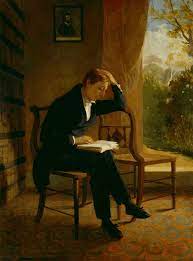
Students invariably encounter the works of gifted writers at school and university, in many cases through their peak accomplishments. But where the language flows in traditional verse of a timeless quality, it is almost granted by exception, not as the standard by which great utterances are made. The approach to teaching Shakespeare today is to overlay his texts with modern interpretations and productions, such that the essence which made them truly great is oftentimes obscured. Who can come to appreciate the genius of Shakespeare and the immortal lines given by his characters when prince Hamlet is foiled by Hamletmachine? Not even Laertes could have struck him a blow so fatal to life and memory. The finest examples of poetic feeling and characterisation are preserved in word and recollection precisely because they were transmitted via reliable convention, not in spite of it. And the practitioners themselves embraced the challenge of writing within established norms; far from being the hidebound acolytes of an esoteric tradition, they adapted the form their subject. Wordsworth even penned a sonnet saluting the form itself:
Nuns fret not at their convent’s narrow room;
And hermits are contented with their cells;
And students with their pensive citadels;
Maids at the wheel, the weaver at his loom,
Sit blithe and happy; bees that soar for bloom,
High as the highest Peak of Furness-fells,
Will murmur by the hour in foxglove bells:
In truth the prison, into which we doom
Ourselves, no prison is: and hence for me,
In sundry moods, ’twas pastime to be bound
Within the Sonnet’s scanty plot of ground;
Pleased if some Souls (for such there needs must be)
Who have felt the weight of too much liberty,
Should find brief solace there, as I have found.Nuns Fret Not at Their Convent’s Narrow Room, by William Wordsworth
Seen as a worthy mental exercise, writers shaped their fancies to a poetic standard, caging it within established norms—the better to be displayed. For the same reason we continue to set paintings in frames, plays on stages, and words in books, to present art in a manner that underscores its merit by accentuating its recognisability.
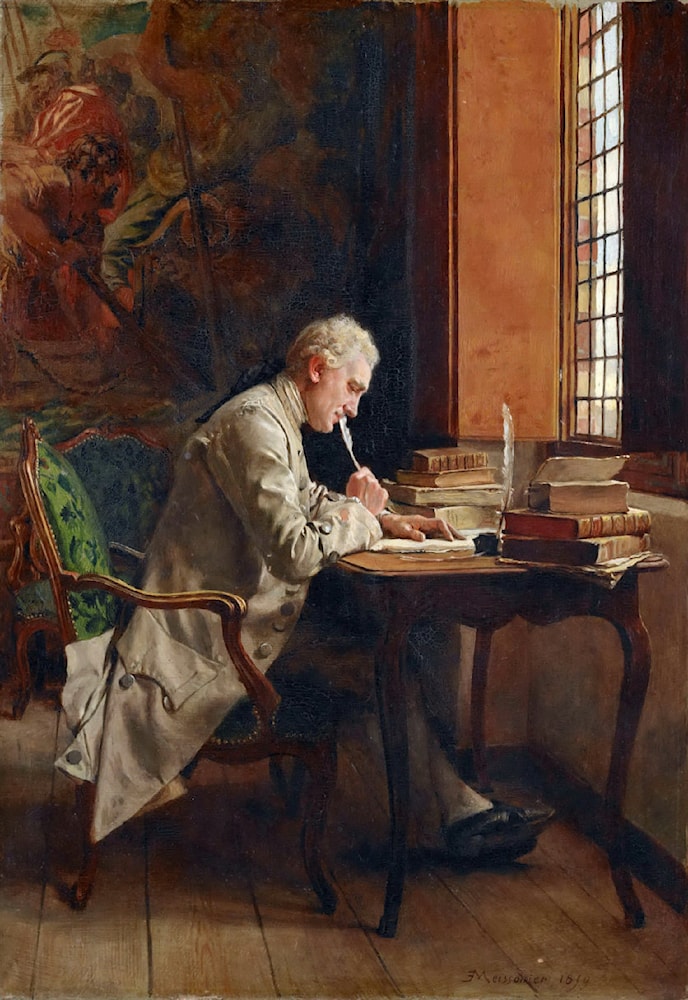
Where it comes to poetry, the challenge to conventional form can hardly be understated. Not satisfied with the recent shift in aesthetic standards, there are some who would undo the limits imposed by language entirely: of grammatical structure, style and diction, even punctuation. How does this promote the longevity of art as words become a purely subjective creation, shortened and disjoined from their provenance? Complicating matters further is the fact that language is being employed by distinct cultures with increasing possessiveness. Whereas profanity and slang has often been found to typify underprivileged and rebellious subsets of society, formal elocution is claimed (or dismissed) as the product of snootiness and toffery. Perhaps the constructs of language can be regarded as existing on a continuum, from unvarnished commonplace utterances to contrivances of astounding artistic quality and merit. It is however a fragile social construct barely serving to unite its speakers.
It can be argued that thought is not detachable from language, and the quality of thoughts are dependent on the mechanism used to express them. This being the case, we in this technological age have much to learn from those who leant on words to advance enduring ideas and sentiments. We ought to welcome instruction from the past, to be educated by those who wielded language to great achievement. Where poetry is concerned, the conventions of form if obeyed, may be modified to generate new modes of expression. For instance, the Alexandrine, Spenserian stanza and Petrarchan sonnet have been adopted by numberless rhymers to suit their subject. The number of lines and rhymes in poetic units were adjusted, but not the entire structure of stanzaic writing. Offering excessive freedom in poetic composition risks a decline in discipline and quality. If we read and refer often to esteemed writers of past, and incorporate their phrases into our speech, we may perchance elevate our own thoughts and expressions. Certainly much ink has been spilt on questions still facing us today, and by following the mannerism of past thinkers our own is surely enriched. Rather than passing nonchalantly by those past masters of poetry, language and written expression (as we might do with their likenesses cast in bronze), let us return to them, allowing ourselves to be transformed and raised to their heights, even to soar beyond them. Then we too shall rightly endure, adding our voices to those worth hearing.
 Caged Fancy